KNM: Hoogtepunten Nederlandse Geschiedenis
Understanding Dutch history helps you understand modern Netherlands. Key periods include: the Golden Age (17th century, trade and art), the struggle for i...
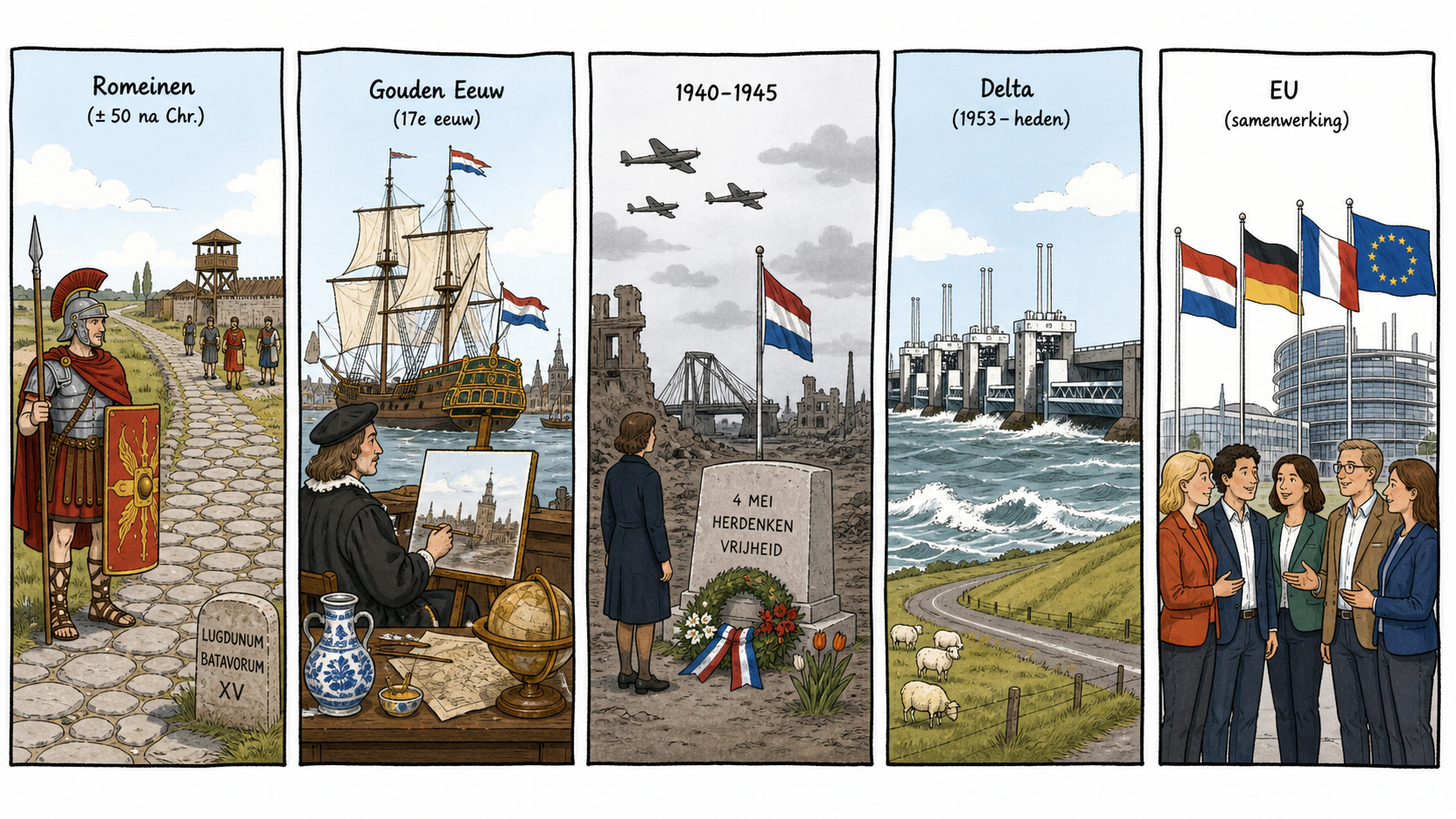
Understanding Dutch history helps you understand modern Netherlands. Key periods include: the Golden Age (17th century, trade and art), the struggle for independence from Spain, World War II and the German occupation (1940-1945), and the post-war 'wederopbouw' (reconstruction).
| Period | Dutch | Significance |
|---|---|---|
| Romans | Romeinen | Early towns and roads in the south of the Netherlands |
| Middle Ages | Middeleeuwen | Towns, castles, churches, and local rulers |
| French period | Franse tijd / Napoleon | New laws and administration before the kingdom |
| Kingdom | Koninkrijk | The Netherlands became a kingdom in the 19th century |
| Golden Age | Gouden Eeuw | 1600s, trade, art (Rembrandt), VOC |
| Independence | Tachtigjarige Oorlog | 1568-1648, freedom from Spain |
| WWII Occupation | Duitse bezetting | 1940-1945, suffering, resistance |
| Liberation | Bevrijding | May 5, 1945, by Allied forces |
| Reconstruction | Wederopbouw | Post-1945, rebuilding nation |
| Flood disaster | Watersnoodramp | 1953, led to Delta Works |
| Constitutional democracy | Grondwet / Thorbecke | 1848, ministers became responsible to parliament |
| Social laws | Kinderwet / leerplicht | Child labor was limited and school became compulsory |
| Voting rights | Vrouwenkiesrecht | Women received the right to vote in 1919 |
| Post-war migration | Indonesie, Suriname, gastarbeiders | New communities came to the Netherlands after 1945 |
| European cooperation | Europese Unie / euro | The Netherlands works with other EU countries |
| Key Detail | Dutch | Why It Matters |
|---|---|---|
| William of Orange | Willem van Oranje | Leader of the Dutch revolt against Spain; ancestor of the royal family |
| National anthem | Het Wilhelmus | The Dutch national anthem is connected to Willem van Oranje |
| Leiden relieved | Leidens Ontzet | Leiden was freed during the Eighty Years' War; herring and white bread are part of the story |
| Republic | Republiek | From 1588, the northern Netherlands continued without the Spanish king |
| Trade companies | VOC en WIC | Important companies in world trade and colonial history during the Golden Age |
| French period | Napoleon | Brought administration changes such as civil registration and family names |
| Constitutional change | Thorbecke | Helped build parliamentary democracy and ministerial responsibility |
| First social law | Kinderwetje van Van Houten | Limited child labor |
| Women's rights | Aletta Jacobs | Important figure for women's education and voting rights |
| Hunger Winter | Hongerwinter | Severe food shortage in 1944-1945 during World War II |
| Welfare state | Willem Drees | Associated with post-war rebuilding and the start of AOW |
| Modern migration | Indonesie, Suriname, gastarbeiders | People came from former colonies and from countries such as Turkey and Morocco |
| International cooperation | NAVO, Europese Unie, euro | The Netherlands cooperates in defense, politics, trade, and currency |
| Integration law | Inburgeringswet | Rules about civic integration and learning Dutch society |
Voorbeelden
- Wanneer was de Gouden Eeuw?
- When was the Golden Age?
- De Gouden Eeuw was in de 17e eeuw.
- The Golden Age was in the 17th century.
- Nederland was bezet door Duitsland.
- The Netherlands was occupied by Germany.
- Op 5 mei vieren we de bevrijding.
- On May 5 we celebrate the liberation.
Studienotitie
Visit the Anne Frank House in Amsterdam or the Nationaal Monument on Dam Square to understand WWII's impact. The Rijksmuseum and Van Gogh Museum showcase Dutch art history. Many towns have local history museums. Understanding the past helps you appreciate Dutch directness about freedom and tolerance.
Oefen na het lezen
Train kennis van de Nederlandse maatschappij met getimede KNM-oefenvragen.
Combineer KNM met de andere onderdelen van het inburgeringsexamen.